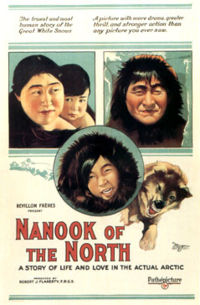
Robert Flaherty filmed "Nanook of the North" in 1920 and 1921, releasing the silent documentary to an eager public in 1922. Flaherty's work documented the "epic" and "exotic" life of Nanook, an Inuit (then-called Eskimo) living in the arctic region of Hudson Bay (Canada) with his family. Flaherty pioneered film as "exploration" and met with great success when he revealed the ethnographic "truths" of the Inuit to the Western world. His ground-breaking work ushered in (as its necessary companion) a series of crises: the truth of ethnographic images (filmed, photographed, or otherwise); the role of the filmmaker/ethnographer (ethical, constructivist, participatory); the method of constructing and presenting the story (or truth) of the text; the purpose or usefulness of the completed text (ethnography or ethnographic film), in other words, "how" the text will be used.
Screening: dvd only
How I Filmed Nanook of the North
One World Magazine
Silent Film Sources Review


1 comment:
شركة نور الحرمين
شركة تنظيف مساجد بالخبر
شركة تنظيف مجالس بالقطيف
شركة تنظيف خزانات بالقطيف
شركة تنظيف موكيت بالقطيف
شركة تنظيف فلل بالقطيف
Post a Comment